
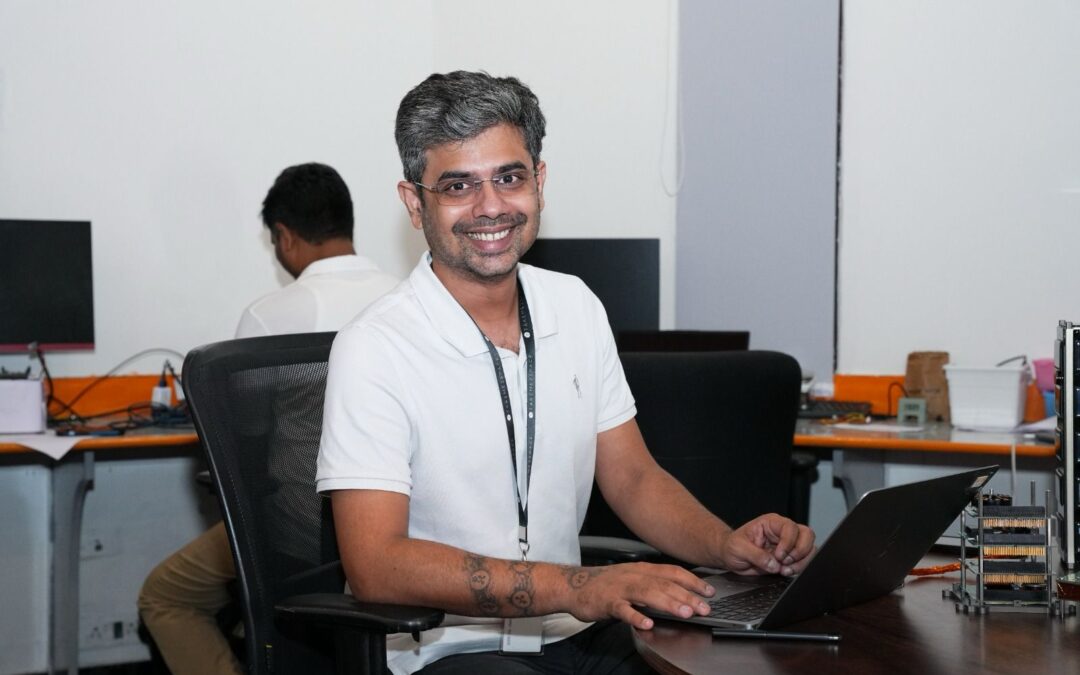
TakeMe2Space’s PowerBank-50 earned its flight heritage powering a customer payload at 450 km (280 miles) aboard Skyroot’s Vikram-1, the mission that made India only the third nation where a privately built rocket has reached orbit. It now ships off the shelf worldwide at a fraction of the cost of comparable imported packs, putting the satellite industry’s hardest-earned credential within reach of every builder, from university CubeSat teams to commercial constellations.
San Francisco, July 30, 2026: TakeMe2Space today announced that its PowerBank-50 satellite battery pack is officially space-proven, having successfully completed its first mission aboard Skyroot Aerospace’s Vikram-1 on its maiden flight, Mission ‘Aagaman,’ launched from Satish Dhawan Space Centre, Sriharikota, on July 18, 2026.
The mission was a global milestone widely described as India’s “SpaceX moment.” Vikram-1 became the first privately developed Indian rocket to reach orbit, making India only the third country in the world, after the United States and China, where a private company has achieved orbital launch capability. Riding on that historic flight, a single PowerBank-50 unit powered Cosmoserve Space’s experimental payload on the launch vehicle’s Orbital Adjustment Module (OAM) at an altitude of 450 km (about 280 miles), performing exactly as designed through the violence of launch and the vacuum, radiation and temperature swings of space.
With this flight, PowerBank-50 graduates from a tested product to a flight-proven one, the distinction that defines the global satellite components market.
“Every satellite mission lives or dies by its power system, which is why nobody wants to be the first to fly a new battery. We are grateful that Cosmoserve trusted PowerBank-50 on a mission of this significance. Flying on the first private Indian rocket to reach orbit, and performing flawlessly at 450 km, is the strongest validation a product can earn. PowerBank-50 is now space proven, made in India, and ready for every satellite builder in the world,” said Ronak Kumar Samantray, Founder and CEO, TakeMe2Space.
Why “space-proven” is the credential that matters
In the satellite industry, flight heritage is the hardest credential to earn and the first question every buyer asks. Satellite builders, launch providers and insurers are deeply reluctant to fly components that have never flown, because a single subsystem failure can end a multimillion-dollar mission. This creates the industry’s best-known catch-22: you cannot get
heritage without flying, and you cannot fly without heritage. PowerBank-50 has now broken through that barrier.
The bar is highest of all for batteries. They are among the most safety-scrutinized components on any rocket: they must survive intense launch vibration and shock, then operate reliably in vacuum through extreme hot and cold cycles every orbit. On this mission, PowerBank-50 validated its entire chain in the real environment: its high-energy-density lithium-ion cells, its intelligent battery management system, its cell heaters and its aluminum flight enclosure. The product has moved from qualified on the ground to proven in orbit, the highest level of technology readiness.
Available off the shelf today
PowerBank-50 is available off the shelf today at a fraction of the cost of comparable imported packs, with a lead time of one to two months. Current pricing and full technical specifications are published on the company’s product page. Satellite teams anywhere in the world can now buy a flight-proven power system the way they buy any other off-the-shelf hardware: from a catalog, without a custom procurement cycle.
For the fast-growing small-satellite sector, from university CubeSat programs to venture-backed constellation startups counting every line of the bill of materials, and for manufacturers looking to diversify their supplier base, that changes the math on satellite power. A proven, affordable battery lowers the cost of putting a satellite in orbit, which means more startups, universities and students can fly.
What is new about PowerBank-50
PowerBank-50 packs more than 50 Wh of energy storage into a unit the size of a paperback, weighing 380 grams (13.4 ounces). It uses cells with among the highest energy density available for small satellites, carries onboard intelligence that manages, balances and reports the battery’s health to operators on the ground, and keeps itself warm through the extreme cold of orbit. Packs can be stacked to power anything from a CubeSat to a microsatellite, with a mission life of up to five years in low Earth orbit. Full technical specifications are available on the product page.
Why it matters beyond the industry
Satellites quietly run much of daily life: the weather forecast before a farmer sows a crop, the maps that guide a delivery driver, hurricane and cyclone warnings on the coast, broadcasts, and crop and water surveys. Every satellite shares the same weakness. For part of every orbit it passes through Earth’s shadow, where its solar panels go dark. In those minutes, the battery alone keeps the satellite alive. If the battery fails, the satellite dies. Cheaper, proven power systems mean more satellites, better forecasts, sharper disaster warnings, smarter farming and wider connectivity.
About TakeMe2Space
TakeMe2Space is building next-generation orbital infrastructure focused on in-space computing, data processing and orbital data centers. Through its MOI constellation and space-based computing platforms, the company is developing technologies that enable data to be processed, analyzed and distributed directly in orbit. PowerBank-50’s flight heritage is the first orbital validation of the hardware stack behind that roadmap.
Media Contact
Srishti Vatsa · +91 98670 44794 · srishti@moatglobal.com Priya M · +91 6363620273 · priya@moatglobal.com