
When, in February 2026, the massive SLS rocket lifts off from the launch pad at NASA’s Kennedy Space Center in Florida with four astronauts on board, six chips designed to measure cosmic radiation supplied by ADVACAM will travel with them toward the Moon. These components form a key part of the HERA (Hybrid Electronic Radiation Assessor) system. The instrument, developed by NASA, is designed to monitor the composition of cosmic radiation, which can have a significant impact on crew health as well as on the performance of sensitive onboard electronics. The device will also help verify the effectiveness of radiation shielding aboard the spacecraft.
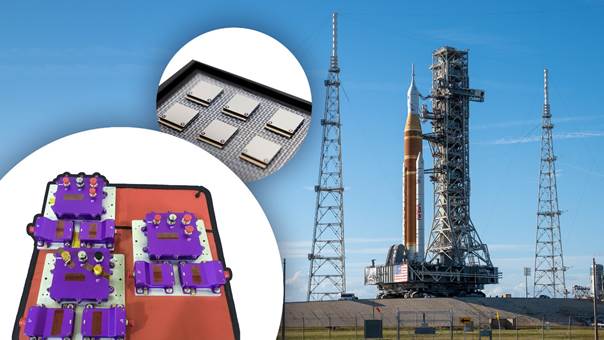
Source: The SLS launch vehicle, a detail of the HERA system installed in the Orion spacecraft, and Timepix chips NASA / SRAG-JSC / ADVACAM
For NASA, Artemis II represents the first crewed mission to the Moon since Apollo 17 in 1972. The first launch window is scheduled for February 6, 2026. The astronauts will not land on the lunar surface during this mission. Instead, during the ten-day test flight, they will orbit the Moon and test all critical life-support systems aboard the Orion spacecraft. This mission thus serves as the final rehearsal before the planned return of astronauts to the lunar surface as part of the Artemis III mission, scheduled for the following years.
ADVACAM Technology as a Standard
ADVACAM is a NASA-certified supplier of technologies for monitoring cosmic radiation. Since 2013, the company has delivered dozens of complete detectors or chip modules based on Timepix technology.
“These are extremely sensitive pixel chips capable of detecting every single particle of cosmic radiation and determining its energy, direction, interaction time, and particle type. This allows not only the measurement of the total radiation dose, but, more importantly, a detailed analysis of its composition. That is essential because different types of cosmic particles have different effects,” explains ADVACAM’s Scientific Director, Jan Jakůbek.
These chips are integrated into two HSU (Hera Sensor Unit) units. Each unit contains three Timepix modules. The HERA system autonomously processes the measured data and provides the crew with dosimetric information, including alerts and warnings during significant radiation events.
“The use of our technology in this program is a major success for the company and a clear indication that detailed radiation measurement is becoming an increasingly important part of human spaceflight. This applies both to missions in Earth orbit and to deeper-space missions, where radiation levels increase significantly. We are proud that NASA plans to use our chips as well during the final attempt to land on the Moon as part of the Artemis III mission,” adds ADVACAM CEO Jan Sohar.
A Key Component for Scientific and Commercial Missions
Beyond the Artemis program, Timepix chip modules and complete radiation detectors marketed under the MiniPIX SPACE brand have been used in a wide range of other space missions. These include deployments aboard the International Space Station (ISS), the OneWeb Joey Sat satellite, and the VZLUSAT I and II CubeSats. Radiation monitoring will also be conducted inside the future lunar orbital station Gateway as part of the ESA IDA (Internal Dosimetry Array) system. (Read more)
Teams involved in the development and production of these detectors plan to increasingly focus on the processing and delivery of radiation data itself. As part of the AdVisiones Technologies group, which also includes ADVACAM, a new subsidiary, AdvaSpace, was established at the end of 2025.
“Our goal is to develop software tools for the interpretation of radiation data and to build, using MiniPIX SPACE detectors, a satellite constellation that would share space weather data with other satellites, as well as with aviation companies, operators of power transmission networks, or insurance providers—much like meteorological satellites provide information about terrestrial weather. At present, we are in the preparation phase and are looking for potential partners and investors for this ambitious vision,” says Martin Tyburec, Director of AdvaSpace.
From Fundamental Matter Research to the Moon
Timepix technology originated in particle physics research at the CERN Large Hadron Collider (LHC), where the future founders of ADVACAM were involved in its development. ADVACAM operates under a license from the Medipix Collaboration, whose mission is the further development and commercialization of this chip technology. ADVACAM and AdvaSpace are members of the AdVisiones Technologies technology hub.
ADVACAM s.r.o.
Imaging the Unseen
We reveal what no one else can see. We design and manufacture cameras for imaging invisible radiation. Discover a technology of exceptionally sensitive, fast, and precise detectors capable of identifying every individual particle.
AdvaSpace s.r.o.
Radiation Data Intelligence
A provider of solutions for space weather monitoring and radiation data interpretation.
AdVisiones Technologies a.s.
A hub for imaging innovation
You can find us in orbit as well as in hospitals, industrial laboratories, and art studios. We seek new ways to apply state-of-the-art detectors capable of capturing individual particles. We invest in new visions in digital X-ray imaging and particle detection. We are AdVisiones Technologies—a technology hub for innovation in imaging.
For further information, please contact:
Barbora Velebilová
Communications Specialist, AdVisiones Technologies
+420 605 336 695
barbora.velebilova@advisiones.com
Additional sources:
https://advacam.com/application/space/
https://www.nasa.gov/artemis-ii-press-kit/
https://wrmiss.org/workshops/twentysixth/Semones.pdf
https://www.sciencedirect.com/science/article/pii/S2214552423000226